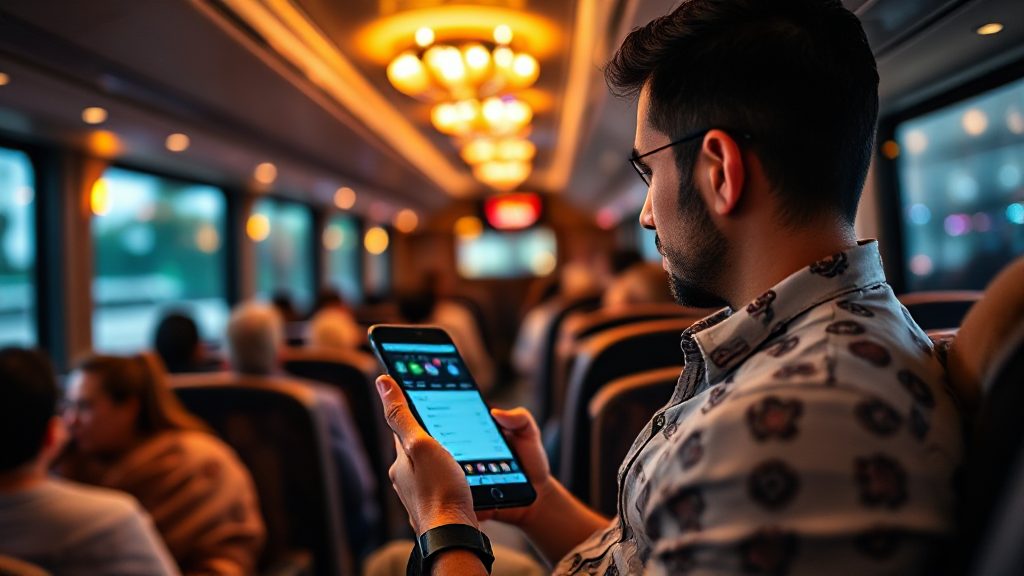
Betting on tk999 Between Buses, Queues and Trips
There is a crowded bus, a phone held in one hand, a thumb hovering over a screen, and the quiet realisation that the same app feels entirely different depending on where you open it. That is the starting point for anyone who uses tk999 as a Bangladeshi betting and gaming platform: context does not just change how you feel about the session, it changes the decisions you make inside it. This article looks at how the platform fits into commutes, long journeys, waiting rooms and late nights at home, and why a bus seat is not the same as a quiet room.
Why the same app feels different on a moving bus
On a Dhaka-bound bus, the phone is held low, the screen brightness is turned down, and the session is measured in minutes between stops. The environment forces a kind of shorthand: quick logins, small checks, and an instinct to close the app before the next bump. That is not a flaw in the platform, but it does shape behaviour. Environment sets the pace of every betting session, and the pace is often faster and less deliberate when you are standing in a moving vehicle.
The practical lesson is that tk999 is designed to be reachable from a phone, including through its downloadable app, but reachability is not the same as suitability. A commute is a good place to register an account, check a balance or read a notification. It is a poor place to make a considered decision about a wager, because the noise, the movement and the risk of missing your stop all compete for attention.
Frequent travellers tend to develop a simple rule: use the commute for the boring parts of the experience and keep the meaningful parts for a settled moment. The platform does not enforce that rule, but the people who use it well tend to arrive at it themselves.
Long trips: when hours become the problem
A three-hour bus or train journey is a different animal from a ten-minute commute. Time stops being scarce and starts being abundant, and abundance is where careless decisions creep in. The same tk999 session that felt rushed at a bus stop now has room to stretch, and stretching is not always healthy. Long trips reward a pre-set limit more than any other context, because the temptation is to fill empty time rather than to act on a clear intention.
There is also a practical side. Connectivity on intercity routes in Bangladesh is uneven: signal drops between districts, data packs run out, and a session that relies on a stable connection can stall mid-step. Travellers who know this tend to prepare before boarding — checking that the app is updated, that the login details are saved, and that they are not depending on a weak signal for something time-sensitive.
What to prepare before a long journey
- Confirm the tk999 app is updated while you still have reliable Wi-Fi or mobile data.
- Decide in advance how much time and money the trip is allowed to absorb.
- Keep login details somewhere you can reach without a data connection.
- Accept that some stretches of the route will simply have no usable signal.
None of this is exotic advice, but it is the difference between a trip that includes a little gaming and a trip that becomes a long, drifting session. The context of a moving vehicle makes the second outcome far more likely if you have not set the first one up in advance.
Waiting rooms, queues and the ten-minute window
A hospital waiting room, a bank queue, a bus counter — these are the places where tk999 most often gets opened for a few minutes and closed again. The defining feature is interruption: you are always about to be called. That makes waiting rooms surprisingly good for the administrative side of the platform and surprisingly bad for anything that needs sustained thought.
Registration is a good example. A new user can begin the sign-up process in a queue, but the steps that require documents, verification or a careful read of terms are better done sitting down. The same applies to deposits and withdrawals: a payment that is started in a queue and interrupted halfway is more likely to need a second attempt. A waiting room is a place for starting things, not finishing them.
There is a social dimension too. In a queue, the screen is visible to strangers, and many users find they behave more conservatively when someone might glance over their shoulder. That is not a bad thing. It is simply another reminder that the room you are in is part of the experience, whether the platform intends it or not.
Late night at home: the opposite context
At home, late at night, everything that made the bus difficult disappears. The screen is bright, the connection is stable, the chair is comfortable, and there is no queue to interrupt you. This is the context where tk999 is easiest to use and, for exactly that reason, the one that needs the most discipline. Comfort removes friction, and friction was doing some of the work for you.
The decisions made in a quiet room tend to be larger and slower than those made on a bus, and that cuts both ways. A user who plans a session at home can follow through properly; a user who drifts into one at midnight can lose track of time in a way that a moving bus would never allow. The fix is not to avoid the platform at home, but to treat the quiet room as the place where limits are set and reviewed, not just where they are tested.
It also helps to separate the two uses. Reading about the platform, checking account settings, and reviewing how a session went are all better done at home than on the move. The app supports all of it; the question is whether the user has decided which context is for which task.
FAQ: using tk999 while travelling
Does tk999 work on mobile data during a journey?
It is built as a mobile-first platform with a downloadable app, so it is intended to work on mobile data. Coverage on intercity routes varies, and signal gaps are normal. Expect some stretches where the app will not load reliably.
Can I register for tk999 while on a bus or train?
You can start the process, but registration usually involves verification steps that are easier to complete with a stable connection and a quiet moment. Starting on the move and finishing at home is the more practical approach.
What should I check before a long trip?
Update the app, confirm your login details are accessible offline, and decide in advance how much of the trip you are willing to give to gaming. Those three checks cover most of the problems travellers run into.
Is it better to use the app or the website while travelling?
The app is generally more convenient on a phone because it is designed for that screen and keeps you signed in. The website remains a useful fallback if the app has not been updated or the device is short on storage.